Lab Color Space: Color Accuracy in Digital Art Reproduction

Zurück zur Übersicht

What the Lab color space is, what L, a, and b stand for — and why Lab is indispensable in the digitization of art.

Anyone who has a work of art digitized expects a color-accurate file. Anyone who commissions a fine art print expects the print to match the original. What sounds simple is technically challenging—because color cannot be reliably described using RGB or CMYK values alone. The Lab color space fills exactly this gap.

Why We Need a Device-Independent Color Space

RGB and CMYK are device-dependent color models. This means that the same RGB value will look different on two different monitors. The same CMYK value will produce different results on two different printers—depending on the ink, paper, machine, and calibration.

This is acceptable for many applications. However, when it comes to reproducing works of art, long-term archiving, or comparing two prints over the course of several years, it poses a fundamental problem: It is impossible to reliably determine whether two files truly represent the same color.

The Lab color space solves this problem by defining color not in terms of devices, but in terms of human perception.

What the Lab color space is

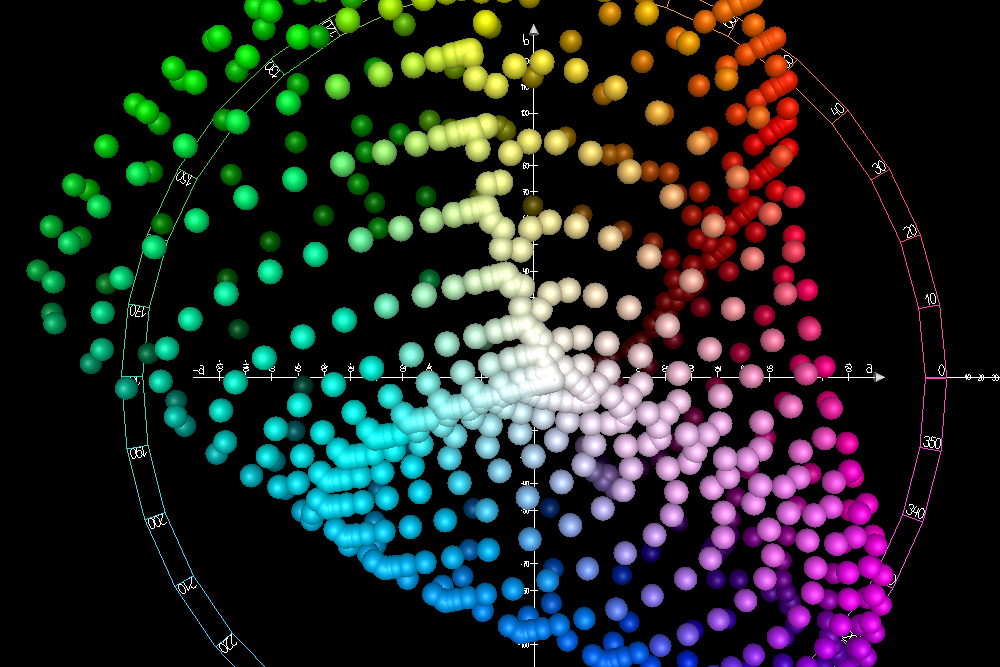
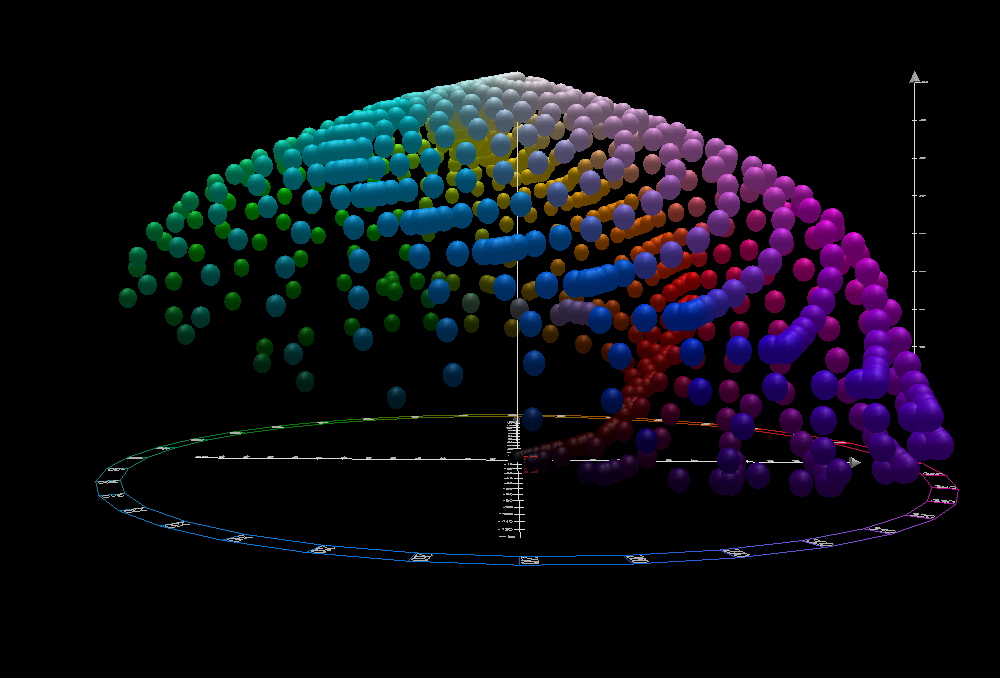
The Lab color space—formally known as CIE L*a*b*—was defined in 1976 by the International Commission on Illumination (CIE). It describes all colors visible to the human eye within a single, device-independent coordinate system. Each color is assigned a unique position in the Lab color space—regardless of which device generates or measures it.

This makes Lab the foundation for professional color management: as a space into and from which all device-dependent profiles are converted, and as a standard for color comparisons.

The three axes: L, a, b

The Lab color space consists of three components:

L — Lightness (Helligkeit)

L describes the lightness value of a color on a scale from 0 (pure black) to 100 (pure white) and is independent of the color itself: A dark red and a dark blue can have the same L value.

a — Green-Red Axis

The a-value describes the shift in a color between green (negative values) and red (positive values). Neutral shades of gray have an a-value close to 0.

b — Blue-Yellow Axis

The b value describes the shift between blue (negative values) and yellow (positive values). Here, too, neutral tones have a value close to 0.

Together, L, a, and b define a unique point in color space—a precise, device-independent description of a color that can be measured and documented using a spectrophotometer.

Delta E: Color Deviation Becomes Measurable

Once two colors are available as Lab values, their difference can be calculated. This difference is called Delta E (ΔE). It indicates how far apart two colors are in the Lab color space—and thus, how much they differ to the human eye.

As a guideline:

Delta EPerception
< 1No perceptible difference
1 – 2Visible only to trained observers
2 – 3.5Visible only to trained observers
> 3.5Clearly noticeable

For color-accurate reproduction of works of art, the goal is a Delta E value below 2—the more critical the work, the tighter the tolerance.

Lab in Practice: Digitization and Reproduction of Art

In professional art digitization, lab values are used in two key areas:

Color Measurement on the Original

Before or during digitization, lab values are measured directly from the original using a spectrophotometer. This measurement documents the exact color state of the artwork at the time the image was captured—regardless of any device used later in the processing chain.

Embedding in the scan file

The measured Lab values are embedded in the digital copy. This creates a color-accurate reference file: It not only describes what the work looks like, but also contains the measurable parameters against which any future reproduction can be compared—today, in five years, or in twenty years. Devices, inks, and materials may change; the Lab values remain as an objective reference.
Expense Control

When producing a fine art print, the measured values of the finished print are compared with the Lab reference values. Only when the Delta E falls within the tolerance range is the reproduction accepted as color-accurate.

One of our Reference-scans follows exactly these steps.

This workflow is not standard in the industry. It requires that all parties involved—from digitization to printing—work with calibrated equipment, standard lighting, and consistent color management.

Conclusion

The Lab color space is the common language of professional color management. It allows colors to be described independently of devices, differences to be measured objectively, and color reproductions to be approved. For anyone who digitizes, reproduces, or archives works of art, understanding Lab values and Delta E is not a technical footnote—it is a fundamental prerequisite for verifiable quality.

Would you like to learn more about how color-accurate digitization works in practice?

Please contact us — we’d be happy to explain our workflow with no obligation.